Saliebt Eye Remote Says No Imge Upload From Camers

The same image viewed past white, blue, green, and red lights reveals different subconscious numbers.
Steganography ( STEG-ə-NOG-rə-fee) is the practice of concealing a message within another bulletin or a physical object. In computing/electronic contexts, a estimator file, message, image, or video is concealed within another file, message, image, or video. The word steganography comes from Greek steganographia, which combines the words steganós ( στεγανός ), meaning "covered or curtained", and -graphia ( γραφή ) meaning "writing".[one]
The first recorded employ of the term was in 1499 by Johannes Trithemius in his Steganographia, a treatise on cryptography and steganography, disguised as a book on magic. More often than not, the subconscious messages appear to exist (or to be function of) something else: images, articles, shopping lists, or some other embrace text. For example, the hidden bulletin may be in invisible ink betwixt the visible lines of a individual letter. Some implementations of steganography that lack a shared surreptitious are forms of security through obscurity, and key-dependent steganographic schemes attach to Kerckhoffs'south principle.[ii]
The advantage of steganography over cryptography lone is that the intended secret message does not concenter attention to itself as an object of scrutiny. Manifestly visible encrypted messages, no thing how unbreakable they are, arouse involvement and may in themselves be incriminating in countries in which encryption is illegal.[3]
Whereas cryptography is the do of protecting the contents of a message lonely, steganography is concerned with concealing the fact that a underground bulletin is existence sent and its contents.
Steganography includes the concealment of information within computer files. In digital steganography, electronic communications may include steganographic coding inside of a transport layer, such as a certificate file, image file, plan, or protocol. Media files are ideal for steganographic transmission considering of their large size. For example, a sender might start with an innocuous prototype file and adjust the color of every hundredth pixel to represent to a letter in the alphabet. The change is so subtle that someone who is not specifically looking for information technology is unlikely to notice the change.
History [edit]

The first recorded uses of steganography can be traced back to 440 BC in Greece, when Herodotus mentions two examples in his Histories.[four] Histiaeus sent a message to his vassal, Aristagoras, by shaving the head of his most trusted retainer, "mark" the message onto his scalp, then sending him on his way once his hair had regrown, with the education, "When thou art come to Miletus, bid Aristagoras shave thy head, and await thereon." Additionally, Demaratus sent a warning about a forthcoming assail to Greece past writing information technology directly on the wooden backing of a wax tablet before applying its beeswax surface. Wax tablets were in mutual use and so as reusable writing surfaces, sometimes used for shorthand.
In his piece of work Polygraphiae, Johannes Trithemius developed his so-chosen "Ave-Maria-Cipher" that can hibernate information in a Latin praise of God. "Auctor Sapientissimus Conseruans Angelica Deferat Nobis Charitas Potentissimi Creatoris" for example contains the concealed word VICIPEDIA.[five]
Techniques [edit]
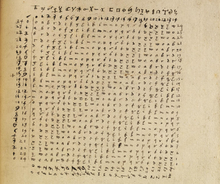
Deciphering the code. Steganographia
Physical [edit]
Steganography has been widely used for centuries. Some examples include:[6]
- Hidden messages on a paper written in secret inks.
- Subconscious messages distributed, according to a certain dominion or key, as smaller parts (due east.g. words or letters) amongst other words of a less suspicious cover text. This item form of steganography is chosen a null cipher.
- Messages written in Morse code on yarn and then knitted into a piece of article of clothing worn by a courier.
- Letters written on envelopes in the surface area covered by postage stamp stamps.
- In the early days of the press printing, it was common to mix unlike typefaces on a printed page because the printer did non have plenty copies of some letters in one typeface. Thus, a bulletin could be subconscious by using two or more different typefaces, such equally normal or italic.
- During and after Globe War Two, espionage agents used photographically-produced microdots to send information back and forth. Microdots were typically minute (less than the size of the menses produced by a typewriter). World War II microdots were embedded in the paper and covered with an adhesive, such every bit collodion that was reflective and then was detectable by viewing confronting glancing light. Alternative techniques included inserting microdots into slits cut into the edge of postcards.
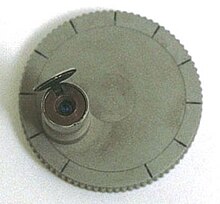
- During World War II, Velvalee Dickinson, a spy for Nippon in New York Metropolis, sent information to accommodation addresses in neutral South America. She was a dealer in dolls, and her letters discussed the quantity and type of doll to ship. The stegotext was the doll orders, and the concealed "plaintext" was itself encoded and gave information near ship movements, etc. Her case became somewhat famous and she became known as the Doll Woman.
- During Earth War Ii, photosensitive glass was declared underground[ by whom? ], and used for transmitting information to Allied armies.
- Jeremiah Denton repeatedly blinked his eyes in Morse code during the 1966 televised printing conference that he was forced into as an American prisoner-of-war past his North Vietnamese captors, spelling out "T-O-R-T-U-R-Due east". That confirmed for the first time to the US Naval Intelligence and other Americans that the North Vietnamese were torturing American prisoners-of-war.
- In 1968, crew members of the USS Pueblo intelligence ship, held as prisoners past N Korea, communicated in sign linguistic communication during staged photo opportunities, to inform the United states that they were not defectors merely captives of the Due north Koreans. In other photos presented to the US, coiffure members gave "the finger" to the unsuspecting North Koreans, in an effort to discredit photos that showed them smile and comfortable.
Digital letters [edit]
Modern steganography methods include:
- Concealing messages within the lowest bits of noisy images or sound files. A survey and evaluation of relevant literature/techniques on the topic of digital image steganography tin exist found here.[vii]
- Concealing data within encrypted information or within random data. The message to muffle is encrypted, then used to overwrite part of a much larger block of encrypted data or a block of random information (an unbreakable nil similar the i-fourth dimension pad generates ciphertexts that look perfectly random without the individual key).
- Chaffing and winnowing.
- Mimic functions convert one file to have the statistical profile of another. This can thwart statistical methods that help creature-force attacks identify the right solution in a ciphertext-only assault.
- Curtained messages in tampered executable files, exploiting back-up in the targeted educational activity set up.
- Pictures embedded in video material (optionally played at a slower or faster speed).
- Injecting imperceptible delays to packets sent over the network from the keyboard. Delays in keypresses in some applications (telnet or remote desktop software) can hateful a filibuster in packets, and the delays in the packets tin can be used to encode data.
- Changing the order of elements in a set.
- Content-Enlightened Steganography hides information in the semantics a human being user assigns to a datagram. These systems offer security against a nonhuman adversary/warden.
- Blog-Steganography. Messages are fractionalized and the (encrypted) pieces are added equally comments of orphaned web-logs (or pivot boards on social network platforms). In this case, the selection of blogs is the symmetric key that sender and recipient are using; the carrier of the hidden message is the whole blogosphere.
- Modifying the echo of a sound file (Repeat Steganography).[8]
- Steganography for sound signals.[9]
- Image bit-plane complexity segmentation steganography
- Including information in ignored sections of a file, such every bit afterward the logical end of the carrier file.[10]
- Adaptive steganography: Skin tone based steganography using a cloak-and-dagger embedding angle.[11]
- Embedding data within the control-flow diagram of a program subjected to command flow assay[12]
Digital text [edit]
- Using non-printing Unicode characters Null-Width Joiner (ZWJ) and Nil-Width Non-Joiner (ZWNJ).[13] [fourteen] These characters are used for joining and disjoining letters in Arabic and Farsi, but can be used in Roman alphabets for hiding information because they have no pregnant in Roman alphabets: because they are "zero-width" they are not displayed. ZWJ and ZWNJ tin can represent "1" and "0". This may likewise be done with en space, figure space and whitespace characters.[fifteen]
- Embedding a secret bulletin in the pattern of deliberate errors and marked corrections in a discussion processing document, using the discussion processor'southward change tracking feature.[16]
- In 2020, Zhongliang Yang et al discovered that for text generative steganography, when the quality of the generated steganographic text is optimized to a certain extent, it may make the overall statistical distribution characteristics of the generated steganographic text more different from the normal text, making it easier to be recognized. They named this phenomenon Perceptual-Statistical Imperceptibility Conflict Outcome (Psic Effect).[17]
Hiding an paradigm within a soundfile [edit]
An image or a text tin can be converted into a soundfile, which is then analysed with a spectrogram to reveal the image. Diverse artists accept used this method to conceal subconscious pictures in their songs, such as Aphex Twin in "Windowlicker" or Ix Inch Nails in their album Year Zero.[xviii]

1. The word "Wikipedia" is drawn using calculator software
2. The image is converted into an sound file

iii. Finally, the audio is analysed through a spectrogram, revealing the initial image

[edit]
In communities with social or regime taboos or censorship, people employ cultural steganography—hiding messages in idiom, pop civilisation references, and other messages they share publicly and assume are monitored. This relies on social context to make the underlying messages visible only to certain readers.[19] [xx] Examples include:
- Hiding a message in the title and context of a shared video or image.
- Misspelling names or words that are pop in the media in a given week, to suggest an alternate meaning.
- Hiding a picture show that can be traced past using Paint or whatever other drawing tool.[ citation needed ]
Steganography in streaming media [edit]
Since the era of evolving network applications, steganography research has shifted from epitome steganography to steganography in streaming media such every bit Voice over Internet Protocol (VoIP).
In 2003, Giannoula et al. adult a data hiding technique leading to compressed forms of source video signals on a frame-by-frame basis.[21]
In 2005, Dittmann et al. studied steganography and watermarking of multimedia contents such every bit VoIP.[22]
In 2008, Yongfeng Huang and Shanyu Tang presented a novel approach to information hiding in low flake-rate VoIP speech stream, and their published work on steganography is the offset-ever effort to improve the codebook partition by using Graph theory forth with Quantization Alphabetize Modulation in low bit-rate streaming media.[23]
In 2011 and 2012, Yongfeng Huang and Shanyu Tang devised new steganographic algorithms that use codec parameters as cover object to realise real-fourth dimension covert VoIP steganography. Their findings were published in IEEE Transactions on Data Forensics and Security.[24] [25] [26]
Cyber-physical systems/Cyberspace of Things [edit]
Academic work since 2012 demonstrated the feasibility of steganography for cyber-physical systems (CPS)/the Internet of Things (IoT). Some techniques of CPS/IoT steganography overlap with network steganography, i.eastward. hiding data in advice protocols used in CPS/the IoT. However, specific techniques hide information in CPS components. For instance, information can be stored in unused registers of IoT/CPS components and in u.s. of IoT/CPS actuators.[27] [28]
Printed [edit]
Digital steganography output may be in the form of printed documents. A message, the plaintext, may be first encrypted by traditional means, producing a ciphertext. Then, an innocuous cover text is modified in some manner and then as to incorporate the ciphertext, resulting in the stegotext. For case, the letter of the alphabet size, spacing, typeface, or other characteristics of a comprehend text can exist manipulated to carry the subconscious message. Only a recipient who knows the technique used tin can recover the message then decrypt it. Francis Bacon developed Bacon'due south naught every bit such a technique.
The ciphertext produced past nigh digital steganography methods, however, is not printable. Traditional digital methods rely on perturbing dissonance in the channel file to hide the message, and as such, the aqueduct file must be transmitted to the recipient with no additional dissonance from the transmission. Press introduces much dissonance in the ciphertext, by and large rendering the message unrecoverable. There are techniques that accost this limitation, one notable example being ASCII Art Steganography.[29]

Yellow dots from a laser printer
Although not classic steganography, some types of modern color laser printers integrate the model, serial number, and timestamps on each printout for traceability reasons using a dot-matrix code made of small, yellowish dots not recognizable to the naked center — see printer steganography for details.
Using puzzles [edit]
The fine art of concealing information in a puzzle tin accept advantage of the degrees of freedom in stating the puzzle, using the starting information to encode a primal inside the puzzle/puzzle prototype.
For example, steganography using sudoku puzzles has every bit many keys as there are possible solutions of a Sudoku puzzle, which is 6.71×10²¹ .[30]
Network [edit]
In 1977, Kent concisely described the potential for covert channel signaling in general network advice protocols, fifty-fifty if the traffic is encrypted (in a footnote) in "Encryption-Based Protection for Interactive User/Computer Communication," Proceedings of the Fifth Data Communications Symposium, September 1977.
In 1987, Girling first studied covert channels on a local area network (LAN), identified and realised 3 obvious covert channels (2 storage channels and 1 timing channel), and his research paper entitled "Covert channels in LAN's" published in IEEE Transactions on Software Engineering, vol. SE-13 of 2, in February 1987.[31]
In 1989, Wolf implemented covert channels in LAN protocols, e.chiliad. using the reserved fields, pad fields, and undefined fields in the TCP/IP protocol.[32]
In 1997, Rowland used the IP identification field, the TCP initial sequence number and acknowledge sequence number fields in TCP/IP headers to build covert channels.[33]
In 2002, Kamran Ahsan made an excellent summary of research on network steganography.[34]
In 2005, Steven J. Murdoch and Stephen Lewis contributed a affiliate entitled "Embedding Covert Channels into TCP/IP" in the "Data Hiding" volume published past Springer.[35]
All information hiding techniques that may be used to substitution steganograms in telecommunication networks can exist classified under the general term of network steganography. This nomenclature was originally introduced by Krzysztof Szczypiorski in 2003.[36] Reverse to typical steganographic methods that use digital media (images, audio and video files) to hibernate data, network steganography uses communication protocols' control elements and their intrinsic functionality. As a result, such methods can be harder to discover and eliminate.[37]
Typical network steganography methods involve modification of the properties of a single network protocol. Such modification can be applied to the PDU (Protocol Information Unit),[38] [39] [40] to the time relations between the exchanged PDUs,[41] or both (hybrid methods).[42]
Moreover, it is viable to utilise the relation betwixt ii or more different network protocols to enable clandestine communication. These applications fall nether the term inter-protocol steganography.[43] Alternatively, multiple network protocols can be used simultaneously to transfer hidden information and and then-called control protocols can be embedded into steganographic communications to extend their capabilities, e.yard. to allow dynamic overlay routing or the switching of utilized hiding methods and network protocols.[44] [45]
Network steganography covers a broad spectrum of techniques, which include, among others:
- Steganophony – the darkening of letters in Voice-over-IP conversations, e.k. the employment of delayed or corrupted packets that would normally be ignored past the receiver (this method is chosen LACK – Lost Sound Packets Steganography), or, alternatively, hiding data in unused header fields.[46]
- WLAN Steganography – transmission of steganograms in Wireless Local Area Networks. A practical example of WLAN Steganography is the HICCUPS arrangement (Subconscious Communication System for Corrupted Networks)[47]
Terminology and Taxonomy [edit]
In 2015, a taxonomy of 109 network hiding methods was presented past Steffen Wendzel, Sebastian Zander et al. that summarized core concepts used in network steganography research.[48] The taxonomy was adult further in recent years by several publications and authors and adjusted to new domains, such as CPS steganography.[49] [50] [51]
Additional terminology [edit]
Discussions of steganography generally use terminology analogous to and consistent with conventional radio and communications applied science. However, some terms announced specifically in software and are easily confused. These are the most relevant ones to digital steganographic systems:
The payload is the data covertly communicated. The carrier is the signal, stream, or data file that hides the payload, which differs from the aqueduct, which typically means the type of input, such as a JPEG prototype. The resulting signal, stream, or data file with the encoded payload is sometimes called the package, stego file, or covert message. The proportion of bytes, samples, or other signal elements modified to encode the payload is called the encoding density and is typically expressed as a number between 0 and i.
In a gear up of files, the files that are considered likely to contain a payload are suspects. A doubtable identified through some type of statistical analysis can be referred to every bit a candidate.
Countermeasures and detection [edit]
Detecting physical steganography requires a conscientious concrete test, including the utilise of magnification, developer chemicals, and ultraviolet calorie-free. It is a time-consuming procedure with obvious resource implications, even in countries that use many people to spy on their fellow nationals. All the same, it is feasible to screen mail of certain suspected individuals or institutions, such as prisons or prisoner-of-state of war (POW) camps.
During World State of war II, pw camps gave prisoners specially-treated paper that would reveal invisible ink. An article in the 24 June 1948 consequence of Newspaper Trade Periodical by the Technical Director of the Us Government Printing Role had Morris S. Kantrowitz describe in general terms the evolution of this paper. Iii paradigm papers (Sensicoat, Anilith, and Coatalith) were used to industry postcards and stationery provided to German language prisoners of state of war in the United states and Canada. If POWs tried to write a hidden message, the special paper rendered it visible. The United states of america granted at least two patents related to the applied science, one to Kantrowitz, U.South. Patent 2,515,232, "Water-Detecting paper and Water-Detecting Coating Composition Therefor," patented xviii July 1950, and an earlier 1, "Moisture-Sensitive Newspaper and the Manufacture Thereof," U.S. Patent 2,445,586, patented xx July 1948. A similar strategy issues prisoners with writing newspaper ruled with a h2o-soluble ink that runs in contact with h2o-based invisible ink.
In computing, steganographically encoded package detection is called steganalysis. The simplest method to detect modified files, withal, is to compare them to known originals. For instance, to discover data beingness moved through the graphics on a website, an annotator can maintain known clean copies of the materials and so compare them against the current contents of the site. The differences, if the carrier is the aforementioned, comprise the payload. In general, using extremely loftier compression rates makes steganography difficult but non impossible. Compression errors provide a hiding place for data, only high compression reduces the amount of information bachelor to concord the payload, raising the encoding density, which facilitates easier detection (in extreme cases, even by casual ascertainment).
In that location are a diverseness of basic tests that can be done to identify whether or not a hugger-mugger message exists. This procedure is not concerned with the extraction of the message, which is a different procedure and a separate step. The most basic approaches of steganalysis are visual or aural attacks, structural attacks, and statistical attacks. These approaches attempt to detect the steganographic algorithms that were used.[52] These algorithms range from unsophisticated to very sophisticated, with early algorithms being much easier to observe due to statistical anomalies that were present. The size of the bulletin that is being hidden is a factor in how difficult it is to detect. The overall size of the comprehend object also plays a factor besides. If the cover object is small and the message is large, this can distort the statistics and make it easier to notice. A larger comprehend object with a small message decreases the statistics and gives it a better chance of going unnoticed.
Steganalysis that targets a detail algorithm has much better success as it is able to key in on the anomalies that are left behind. This is because the analysis can perform a targeted search to discover known tendencies since information technology is enlightened of the behaviors that information technology commonly exhibits. When analyzing an paradigm the least pregnant bits of many images are actually not random. The photographic camera sensor, especially lower-cease sensors are non the best quality and tin can introduce some random bits. This can besides exist affected by the file compression done on the image. Secret letters can exist introduced into the least pregnant $.25 in an prototype and and then hidden. A steganography tool can be used to camouflage the secret bulletin in the least pregnant bits but information technology can introduce a random area that is as well perfect. This surface area of perfect randomization stands out and can be detected past comparison the to the lowest degree significant $.25 to the adjacent-to-least significant $.25 on an image that hasn't been compressed.[52]
Generally, though, in that location are many techniques known to be able to hide messages in data using steganographic techniques. None are, past definition, obvious when users employ standard applications, simply some can be detected by specialist tools. Others, however, are resistant to detection—or rather it is non possible to reliably distinguish data containing a hidden message from data containing only dissonance—even when the nigh sophisticated analysis is performed. Steganography is existence used to conceal and deliver more effective cyber attacks, referred to equally Stegware. The term Stegware was first introduced in 2017[53] to describe whatever malicious performance involving steganography as a vehicle to conceal an attack. Detection of steganography is challenging, and because of that, not an adequate defence. Therefore, the only mode of defeating the threat is to transform data in a way that destroys whatever hidden messages,[54] a process called Content Threat Removal.
Applications [edit]
Use in modern printers [edit]
Some modern reckoner printers use steganography, including Hewlett-Packard and Xerox brand color laser printers. The printers add tiny yellowish dots to each page. The barely-visible dots contain encoded printer serial numbers and date and time stamps.[55]
Example from mod practice [edit]
The larger the encompass message (in binary data, the number of bits) relative to the subconscious message, the easier it is to hide the subconscious message (equally an illustration, the larger the "haystack", the easier it is to hibernate a "needle"). So digital pictures, which contain much information, are sometimes used to hide messages on the Net and on other digital communication media. It is not clear how common this practise actually is.
For example, a 24-bit bitmap uses 8 $.25 to represent each of the three color values (reddish, green, and blue) of each pixel. The blue alone has 28 different levels of blue intensity. The difference between 11111111 and 11111110 in the value for blueish intensity is likely to be undetectable by the human eye. Therefore, the to the lowest degree significant chip can be used more than or less undetectably for something else other than color information. If that is repeated for the green and the cerise elements of each pixel besides, it is possible to encode one alphabetic character of ASCII text for every 3 pixels.
Stated somewhat more formally, the objective for making steganographic encoding hard to notice is to ensure that the changes to the carrier (the original signal) because of the injection of the payload (the point to covertly embed) are visually (and ideally, statistically) negligible. The changes are duplicate from the noise floor of the carrier. All media tin be a carrier, but media with a big amount of redundant or compressible information is better suited.
From an information theoretical bespeak of view, that ways that the channel must take more capacity than the "surface" signal requires. There must be redundancy. For a digital image, it may be noise from the imaging element; for digital sound, information technology may be dissonance from recording techniques or distension equipment. In general, electronics that digitize an analog signal suffer from several noise sources, such every bit thermal noise, flicker racket, and shot racket. The racket provides plenty variation in the captured digital information that information technology tin can be exploited as a noise comprehend for hidden data. In improver, lossy compression schemes (such as JPEG) always introduce some mistake to the decompressed data, and information technology is possible to exploit that for steganographic use, as well.
Although steganography and digital watermarking seem like, they are not. In steganography, the hidden message should remain intact until it reaches its destination. Steganography can be used for digital watermarking in which a message (being simply an identifier) is subconscious in an image so that its source can be tracked or verified (for example, Coded Anti-Piracy) or even just to identify an image (every bit in the EURion constellation). In such a case, the technique of hiding the bulletin (hither, the watermark) must be robust to prevent tampering. However, digital watermarking sometimes requires a brittle watermark, which can be modified easily, to check whether the epitome has been tampered with. That is the primal divergence between steganography and digital watermarking.
Alleged use by intelligence services [edit]
In 2010, the Federal Bureau of Investigation alleged that the Russian foreign intelligence service uses customized steganography software for embedding encrypted text letters inside image files for certain communications with "illegal agents" (agents without diplomatic encompass) stationed abroad.[56]
On April 23, 2019 the U.S. Department of Justice unsealed an indictment charging Xiaoqing Zheng, a Chinese businessman and former Master Engineer at General Electric, with 14 counts of conspiring to steal intellectual property and trade secrets from General Electric. Zheng had allegedly used steganography to exfiltrate 20,000 documents from General Electric to Tianyi Aviation Applied science Co. in Nanjing, Red china, a company the FBI accused him of starting with backing from the Chinese government.[57]
Distributed steganography [edit]
There are distributed steganography methods,[58] including methodologies that distribute the payload through multiple carrier files in diverse locations to make detection more hard. For example, U.South. Patent viii,527,779 past cryptographer William Easttom (Chuck Easttom).
Online challenge [edit]
The puzzles that are presented past Cicada 3301 contain steganography with cryptography and other solving techniques since 2012.[59] Puzzles involving steganography have also been featured in other alternate reality games.
The communications[60] [61] of The May Twenty-four hour period mystery contain steganography and other solving techniques since 1981.[62]
Run across also [edit]
- Acrostic – Text formed from parts of another text
- BPCS-Steganography
- Camera/Shy
- Canary trap – Method for exposing an information leak
- Warrant canary – Method of indirect notification of a subpoena
- Covert channel – Computer security assail
- Cryptography – Practice and study of secure communication techniques
- Deniable encryption – Encryption techniques where an adversary cannot prove that the plaintext data exists
- Digital watermarking
- Invisible ink – Substance used for writing which is invisible and can later exist made visible
- Polybius foursquare – Type of code
- Security engineering – Process of incorporating security controls into an information system
- Semiotics – Report of signs and sign processes
- Steganographic file organization
- Steganography tools
- Audio watermark – Electronic identifier embedded in an audio signal
- Visual cryptography
- Security printing – Field of the printing manufacture
References [edit]
- ^ "Definition of STEGANOGRAPHY". Merriam-webster.com . Retrieved xiv December 2021.
- ^ Fridrich, Jessica; One thousand. Goljan; D. Soukal (2004). Delp Iii, Edward J; Wong, Ping Due west (eds.). "Searching for the Stego Key" (PDF). Proc. SPIE, Electronic Imaging, Security, Steganography, and Watermarking of Multimedia Contents VI. Security, Steganography, and Watermarking of Multimedia Contents Vi. 5306: 70–82. Bibcode:2004SPIE.5306...70F. doi:x.1117/12.521353. S2CID 6773772. Retrieved 23 January 2014.
- ^ Pahati, OJ (2001-eleven-29). "Misreckoning Carnivore: How to Protect Your Online Privacy". AlterNet. Archived from the original on 2007-07-sixteen. Retrieved 2008-09-02 .
- ^ Petitcolas, FAP; Anderson RJ; Kuhn MG (1999). "Information Hiding: A survey" (PDF). Proceedings of the IEEE. 87 (7): 1062–78. CiteSeerX10.1.1.333.9397. doi:10.1109/5.771065. Retrieved 2008-09-02 .
- ^ "Polygraphiae (cf. p. 71f)" (in German). Digitale Sammlungen. Retrieved 2015-05-27 .
- ^ "The Wartime Spies Who Used Knitting as an Espionage Tool – Atlas Obscura". Pocket . Retrieved 2020-03-04 .
- ^ Cheddad, Abbas; Condell, Joan; Curran, Kevin; Mc Kevitt, Paul (2010). "Digital image steganography: Survey and analysis of current methods". Signal Processing. 90 (3): 727–752. doi:ten.1016/j.sigpro.2009.08.010.
- ^ "Archived copy". Archived from the original on 2018-11-06. Retrieved 2019-09-17 .
{{cite web}}: CS1 maint: archived copy equally title (link) - ^ "Secure Steganography for Audio Signals" (PDF). Wseas.u.s.a. . Retrieved xiv December 2021.
- ^ Bough, W.; Gruhl, D.; Morimoto, N.; Lu, A. (1996). "Techniques for data hiding" (PDF). IBM Systems Journal. IBM Corp. 35 (3.4): 313–336. doi:10.1147/sj.353.0313. ISSN 0018-8670. S2CID 16672162. Archived from the original (PDF) on 2020-06-11.
- ^ Cheddad, Abbas; Condell, Joan; Curran, Kevin; Mc Kevitt, Paul (2009). "A skin tone detection algorithm for an adaptive arroyo to steganography". Bespeak Processing. 89 (12): 2465–2478. doi:10.1016/j.sigpro.2009.04.022.
- ^ El-Khalil, Rakan; Keromytis, Angelos D. (2004), "Hydan: Hiding Information in Program Binaries", Information and Communications Security, Berlin, Heidelberg: Springer Berlin Heidelberg, pp. 187–199, doi:10.1007/978-3-540-30191-2_15, ISBN978-3-540-23563-vii , retrieved 2020-10-04
- ^ Akbas E. Ali (2010). "A New Text Steganography Method Past Using Not-Printing Unicode Characters" (PDF). Eng. & Tech. Journal. 28 (1).
- ^ Aysan, Zach (December 30, 2017). "Nada-Width Characters". Retrieved Jan two, 2018.
In early 2016 I realized that it was possible to use cipher-width characters, like aught-width non-joiner or other zero-width characters like the null-width space to fingerprint text. Fifty-fifty with simply a single type of zero-width character the presence or non-presence of the non-visible character is plenty bits to fingerprint even the shortest text.
- ^ Aysan, Zach (Jan one, 2018). "Text Fingerprinting Update". Retrieved Jan 2, 2018.
- ^ T. Y. Liu and Westward. H. Tsai, "A New Steganographic Method for Data Hiding in Microsoft Word Documents past a Modify Tracking Technique," in IEEE Transactions on Information Forensics and Security, vol. 2, no. 1, pp. 24–30, March 2007. doi:10.1109/TIFS.2006.890310 [1]
- ^ Yang, Z., Zhang, S., Hu, Y., Hu, Z., & Huang, Y. (2020). VAE-Stega: Linguistic Steganography Based on Variational Auto-Encoder. IEEE Transactions on Data Forensics and Security.
- ^ Dachis, Adam. "How to Hibernate Secret Messages and Codes in Audio Files". Lifehacker . Retrieved 2019-09-17 .
- ^ Social Steganography: how teens smuggle meaning past the potency figures in their lives, Boing Boing, May 22, 2013. Retrieved June 7, 2014.
- ^ Social Steganography, Scenario Magazine, 2013.
- ^ Giannoula, A.; Hatzinakos, D. (2003). "Compressive information hiding for video signals". Proceedings 2003 International Conference on Image Processing (Cat. No.03CH37429). IEEE. one: I–529–32. doi:10.1109/icip.2003.1247015. ISBN0780377508. S2CID 361883.
- ^ Dittmann, Jana; Hesse, Danny; Hillert, Reyk (2005-03-21). Delp 3, Edward J; Wong, Ping Westward (eds.). "Steganography and steganalysis in voice-over IP scenarios: operational aspects and showtime experiences with a new steganalysis tool set up". Security, Steganography, and Watermarking of Multimedia Contents 7. SPIE. 5681: 607. Bibcode:2005SPIE.5681..607D. doi:10.1117/12.586579. S2CID 206413447.
- ^ B. Xiao, Y. Huang, and S. Tang, "An Approach to Information Hiding in Low Flake-Rate Speech communication Stream", in IEEE GLOBECOM 2008, IEEE, pp. 371–375, 2008. ISBN 978-1-4244-2324-eight.
- ^ Huang, Yong Feng; Tang, Shanyu; Yuan, Jian (June 2011). "Steganography in Inactive Frames of VoIP Streams Encoded by Source Codec" (PDF). IEEE Transactions on Data Forensics and Security. six (two): 296–306. doi:10.1109/tifs.2011.2108649. ISSN 1556-6013. S2CID 15096702.
- ^ Huang, Yongfeng; Liu, Chenghao; Tang, Shanyu; Bai, Sen (December 2012). "Steganography Integration Into a Low-Bit Rate Speech Codec" (PDF). IEEE Transactions on Information Forensics and Security. seven (6): 1865–1875. doi:10.1109/tifs.2012.2218599. ISSN 1556-6013. S2CID 16539562.
- ^ Ghosal, Sudipta Kr; Mukhopadhyay, Souradeep; Hossain, Sabbir; Sarkar, Ram (2020). "Application of Lah transform for security and privacy of data through information hiding in telecommunication". Transactions on Emerging Telecommunications Technologies. 32 (2). doi:10.1002/ett.3984. S2CID 225866797.
- ^ Wendzel, Steffen; Mazurczyk, Wojciech; Haas, Georg. "Don't You Bear upon My Nuts: Information Hiding In Cyber Concrete Systems Using Smart Buildings". Proceedings of the 2017 IEEE Security & Privacy Workshops. IEEE.
- ^ Tuptuk, Nilufer; Hailes, Stephen. "Covert channel attacks in pervasive computing". Proceedings 2015 IEEE International Conference on Pervasive Computing and Communications (PerCom).
- ^ Vincent Chu. "ASCII Art Steganography". Pictureworthsthousandwords.appspot.com.
- ^ B.r., Roshan Shetty; J., Rohith; V., Mukund; Honwade, Rohan; Rangaswamy, Shanta (2009). "Steganography Using Sudoku Puzzle". 2009 International Conference on Advances in Recent Technologies in Communication and Calculating. pp. 623–626. doi:10.1109/ARTCom.2009.116. ISBN978-i-4244-5104-3. S2CID 7850622.
- ^ Girling, C.G. (February 1987). "Covert Channels in LAN's". IEEE Transactions on Software Engineering science. SE-13 (2): 292–296. doi:10.1109/tse.1987.233153. ISSN 0098-5589. S2CID 3042941.
- ^ M. Wolf, "Covert channels in LAN protocols," in Proceedings of the Workshop on Local Surface area Network Security (LANSEC'89) (T.A. Berson and T. Beth, eds.), pp. 91–102, 1989.
- ^ Rowland, Craig H. (1997-05-05). "Covert channels in the TCP/IP protocol suite". Start Monday. 2 (5). doi:ten.5210/fm.v2i5.528. ISSN 1396-0466.
- ^ Kamran Ahsan, "Covert Aqueduct Analysis and Data Hiding in TCP/IP," MSc Thesis, University of Toronto, 2002.
- ^ Murdoch, Steven J.; Lewis, Stephen (2005), "Embedding Covert Channels into TCP/IP", Information Hiding, Springer Berlin Heidelberg, pp. 247–261, doi:ten.1007/11558859_19, ISBN9783540290391
- ^ Krzysztof Szczypiorski (4 November 2003). "Steganography in TCP/IP Networks. State of the Art and a Proposal of a New System – HICCUPS" (PDF). Establish of Telecommunications Seminar . Retrieved 17 June 2010.
- ^ Patrick Philippe Meier (v June 2009). "Steganography 2.0: Digital Resistance against Repressive Regimes". irevolution.wordpress.com . Retrieved 17 June 2010.
- ^ Craig Rowland (May 1997). "Covert Channels in the TCP/IP Suite". First Monday Journal . Retrieved sixteen June 2010.
- ^ Steven J. Murdoch & Stephen Lewis (2005). "Embedding Covert Channels into TCP/IP" (PDF). Information Hiding Workshop . Retrieved 16 June 2010.
- ^ Kamran Ahsan & Deepa Kundur (December 2002). "Practical Data Hiding in TCP/IP" (PDF). ACM Wksp. Multimedia Security. Archived from the original (PDF) on 29 Oct 2012. Retrieved 16 June 2010.
- ^ Kundur D. & Ahsan K. (April 2003). "Practical Internet Steganography: Data Hiding in IP" (PDF). Texas Wksp. Security of Information Systems. Archived from the original (PDF) on 29 Oct 2012. Retrieved 16 June 2010.
- ^ Wojciech Mazurczyk & Krzysztof Szczypiorski (November 2008). "Steganography of VoIP Streams" (PDF). Lecture Notes in Computer Science (LNCS) 5332, Springer-Verlag Berlin Heidelberg, Proc. of The tertiary International Symposium on Information Security (IS'08), Monterrey, United mexican states . Retrieved sixteen June 2010.
- ^ Bartosz Jankowski; Wojciech Mazurczyk & Krzysztof Szczypiorski (11 May 2010). "Data Hiding Using Improper Frame Padding". arXiv:1005.1925 [cs.CR].
- ^ Wendzel, Steffen; Keller, Joerg (20 October 2011). Depression-Attention Forwarding for Mobile Network Covert Channels. 12th Joint IFIP TC6 and TC11 Conference on Communications and Multimedia Security (CMS). Lecture Notes in Informatics. Vol. 7025. pp. 122–133. doi:10.1007/978-3-642-24712-5_10. ISBN978-3-642-24711-8 . Retrieved 4 September 2016.
- ^ Mazurczyk, Wojciech; Wendzel, Steffen; Zander, Sebastian; Houmansadr, Amir; Szczypiorski, Krzysztof (2016). Information Hiding in Advice Networks: Fundamentals, Mechanisms, and Applications (one ed.). Wiley-IEEE. ISBN978-ane-118-86169-ane.
- ^ Józef Lubacz; Wojciech Mazurczyk; Krzysztof Szczypiorski (Feb 2010). "Vice Over IP: The VoIP Steganography Threat". IEEE Spectrum . Retrieved 11 February 2010.
- ^ Krzysztof Szczypiorski (Oct 2003). "HICCUPS: Hidden Communication System for Corrupted Networks" (PDF). In Proc. of: The Tenth International Multi-Briefing on Advanced Estimator Systems ACS'2003, pp. 31–40 . Retrieved eleven Feb 2010.
- ^ Wendzel, Steffen; Zander, Sebastian; Fechner, Bernhard; Herdin, Christian (2015-04-16). "Pattern-Based Survey and Categorization of Network Covert Channel Techniques". ACM Computing Surveys. 47 (iii): 1–26. doi:x.1145/2684195. S2CID 14654993.
- ^ Mazurczyk, Wojciech; Wendzel, Steffen; Cabaj, Krzysztof (2018-08-27). "Towards Deriving Insights into Data Hiding Methods Using Pattern-based Approach". Proceedings of the 13th International Conference on Availability, Reliability and Security: ane–10. doi:ten.1145/3230833.3233261. ISBN9781450364485. S2CID 51976841.
- ^ Hildebrandt, Mario; Altschaffel, Robert; Lamshöft, Kevin; Lange, Matthias; Szemkus, Martin; Neubert, Tom; Vielhauer, Claus; Ding, Yongjian; Dittmann, Jana (2020). "Threat Analysis of Steganographic and Covert Advice in Nuclear I&C Systems". International Conference on Nuclear Security: Sustaining and Strengthening Efforts.
- ^ Mileva, Aleksandra; Velinov, Aleksandar; Hartmann, Laura; Wendzel, Steffen; Mazurczyk, Wojciech (May 2021). "Comprehensive analysis of MQTT v.0 susceptibility to network covert channels". Computers & Security. 104: 102207. doi:10.1016/j.cose.2021.102207. S2CID 232342523.
- ^ a b Wayner, Peter (2009). Disappearing Cryptography: Information Hiding: Steganography & Watermarking, Morgan Kaufmann Publishers, Amsterdam; Boston[ ISBN missing ]
- ^ Lancioni, German (2017-10-sixteen). "What's Hidden in That Picture Online? Seeing Through "Stegware"". McAfee.
- ^ Wiseman, Simon (2017). "Defenders Guide to Steganography". doi:10.13140/RG.two.2.21608.98561.
- ^ "Hush-hush Code in Color Printers Lets Government Track You; Tiny Dots Bear witness Where and When Y'all Made Your Print". Electronic Frontier Foundation. 16 October 2005.
- ^ "Criminal complaint by Special Amanuensis Ricci against alleged Russian agents" (PDF). United States Department of Justice.
- ^ "GE Engineer Charged in Elaborate Theft of Trade Secrets". Twinstate Technologies.
- ^ Liao, Xin; Wen, Qiao-yan; Shi, Sha (2011). "Distributed Steganography". 2011 Seventh International Conference on Intelligent Information Hiding and Multimedia Signal Processing. IEEE. pp. 153–156. doi:x.1109/IIHMSP.2011.20. ISBN978-ane-4577-1397-2. S2CID 17769131.
- ^ Jane Wakefield (nine January 2014). "Cicada 3301: The darknet treasure trail reopens". BBC News . Retrieved eleven January 2014.
- ^ "The texts". Maydaymystery.org . Retrieved 2017-11-23 .
- ^ "Recent things". Maydaymystery.org . Retrieved 2017-11-23 .
- ^ "The Mystery". Maydaymystery.org . Retrieved 2017-11-23 .
Sources [edit]
- Wayner, Peter (2002). Disappearing cryptography: information hiding: steganography & watermarking. Amsterdam: MK/Morgan Kaufmann Publishers. ISBN978-1-558-60769-9.
- Wayner, Peter (2009). Disappearing cryptography 3rd Edition: information hiding: steganography & watermarking. Amsterdam: MK/Morgan Kaufmann Publishers. ISBN978-0-123-74479-one.
- Petitcolas, Fabien A.P.; Katzenbeisser, Stefan (2000). Information Hiding Techniques for Steganography and Digital Watermarking. Artech House Publishers. ISBN978-ane-580-53035-4.
- Johnson, Neil; Duric, Zoran; Jajodia, Sushil (2001). Information hiding: steganography and watermarking: attacks and countermeasures. Springer. ISBN978-0-792-37204-2.
- Petitcolas, Fabien A.P.; Katzenbeisser, Stefan (2016). Data Hiding. Artech Business firm Publishers. ISBN978-1608079285.
External links [edit]
- An overview of digital steganography, particularly within images, for the computationally curious by Chris League, Long Island University, 2015
- Steganography at Curlie
- Examples showing images hidden in other images
- Information Hiding: Steganography & Digital Watermarking. Papers and information about steganography and steganalysis research from 1995 to the present. Includes Steganography Software Wiki list. Dr. Neil F. Johnson.
- Detecting Steganographic Content on the Internet. 2002 paper by Niels Provos and Peter Honeyman published in Proceedings of the Network and Distributed System Security Symposium (San Diego, CA, February 6–eight, 2002). NDSS 2002. Internet Society, Washington, D.C.
- Covert Channels in the TCP/IP Suite – 1996 paper by Craig Rowland detailing the hiding of information in TCP/IP packets.
- Network Steganography Middle Tutorials. How-to articles on the subject of network steganography (Wireless LANs, VoIP – Steganophony, TCP/IP protocols and mechanisms, Steganographic Router, Inter-protocol steganography). By Krzysztof Szczypiorski and Wojciech Mazurczyk from Network Security Grouping.
- Invitation to BPCS-Steganography.
- Steganography past Michael T. Raggo, DefCon 12 (1 August 2004)
- File Format Extension Through Steganography by Blake West. Ford and Khosrow Kaikhah
- Computer steganography. Theory and practice with Mathcad (Rus) 2006 paper by Konakhovich Thousand. F., Puzyrenko A. Yu. published in MK-Press Kyiv, Ukraine
brzezinskiluseple2000.blogspot.com
Source: https://en.wikipedia.org/wiki/Steganography
0 Response to "Saliebt Eye Remote Says No Imge Upload From Camers"
Post a Comment